

Last Updated on June 30, 2026 by ThePublic
Did you know that in every major legislative effort to increase the minimum wage over the last two decades, there were 6 major ones and many more smaller ones, it wasn’t just the Republicans who stepped into to consistently block the bills, they even have had a bit of help from Democrats at times. And while republicans have been seen to be the cohesive bloc against raising the federal minimum wage, once even using a filibuster to quash a high-profile standalone bill, there’s more to all of this than simply politics.
It has been exactly 17 years since the federal minimum wage was set at $7.25 an hour (taking effect on July 24, 2009), yet prices have risen by roughly 56% between 2009 and 2026 according to the U.S. Bureau of Labor Statistics’ Consumer Price Index (CPI).
That is a massive increase, and now that many social programs aimed at helping single families and children have been slashed with the federal spending bill, the “One Big Beautiful Bill Act,” it can be substantially harder for parents to make ends meet.
Yet we have just crowned our first trillionaire (on paper at least), while many studies show that corporate profits do not go back into higher wages for their workers, but rather stock buybacks, massive bonuses and compensation packages for CEOs and other managerial positions within the companies, and record dividend payouts to wealthy Wall Street shareholders.
So What is a ‘Living Wage’ Today For a Single Adult?
The Massachusetts Institute of Technology (MIT) and the Economic Policy Institute (EPI) both run cost calculators to establish the average cost of living in the USA based on county-wide statistics. Their numbers are adjusted per county and state.
According to MIT, a single adult with no children needs a national average of roughly $21.20 an hour to survive. In cheap rural counties, that number dips to around $17 to $18, while in expensive cities it easily clears $25 to $30.
The Economic Policy Institute arrives at almost the exact same math: their data shows a national average requirement of roughly $21.50 to $22.00 an hour for a single adult, dipping to $18 in low-cost rural areas and skyrocketing up to $28.70 an hour in expensive metros like New York City.
Essentially, both major data models agree: the old talking point that a single person can live on $15 an hour is completely dead. Today, $21 to $22 an hour is the bare-minimum baseline just to buy groceries, pay rent, and keep the lights on. The problem is, too many Americans are nowhere near that baseline.
Today’s Cost for a Single Person and One Child?
This is where the stark difference of wage growth, or lack thereof, comes into a harsh realization: the system is way behind the reality of today’s economics. The moment a single worker has one child, the financial math completely changes.
The national average living wage for a single parent with a child leaps up drastically, primarily because of childcare costs. In fact, even in North Carolina, data from the Economic Policy Institute and MIT shows a single parent needs between $27 and $38 an hour depending on the county, and that easily climbs past $50 an hour in major metropolitan cities like New York or San Francisco.
These numbers also don’t take into account unpredictable factors like healthcare and prolonged hospital visits, car maintenance, additional school fees, and a host of other costs normally associated with living in this American economy.
Enter the $25 Solution: The Living Wage for All Act
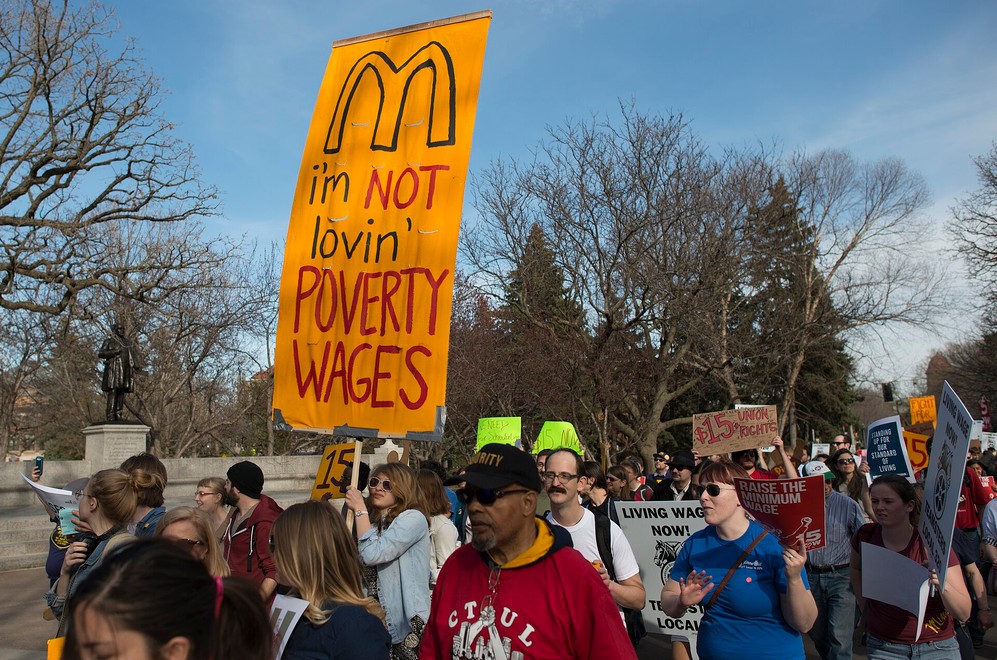
This stark divide between what it costs to survive and what workers are actually paid is exactly why the newly introduced Living Wage for All Act matters so much. This landmark bill looks to finally end poverty wages by phasing in a federal $25-an-hour minimum wage floor.
When critics argue that a sudden jump to $25 will destroy small businesses, the bill is actually building in a realistic, common-sense cushion. It recognizes market power and has included ways to reduce economic disruptions.
Large corporate giants are forced to implement the $25 floor over 6 years (by 2032), while small, local businesses are given a massive 13-year runway (until 2039) to gradually scale up their wages. It also immediately bumps the baseline from $7.25 to $12 in its very first year, giving workers instant breathing room.
The 45% Reality
This isn’t just about a few entry-level jobs. Shockingly, nearly 45% of the entire American workforce currently earns less than $25 an hour, and that number is expanding, not contracting, meaning nearly half of our society is locked out of the basic promise of stability.
Since 1979, American worker productivity has gone up by a massive 92%, yet typical worker wages have risen by less than 34%. Corporate profits are at historic highs because the American workforce is working harder and producing more than ever before, they just aren’t seeing a single dime of that growth in their paychecks.
By now, it should be plain to see that the economic theory of “trickle-down economics” has not effectively given corporations or large businesses the incentives to invest more in their employees. And while public corporations generally have a legal and financial incentive to maximize shareholder value, they are often not created to voluntarily reward employees as part of their business strategy.
They are businesses created to generate the maximum amount of profit possible. If a company didn’t make a financial return on an employee, they most often wouldn’t employ them as they can’t run on loses. That is basic math.
But over the last few decades, that “profit margin” squeezed out of each worker has grown exponentially, while the employees reap increasingly less of the rewards.
This is exactly why government intervention is necessary. We simply cannot rely on corporations to “do the right thing” on their own. Passing a $25 living wage isn’t a handout, it is simply returning the wealth generated by American labor back to the people who actually did the work.
The Blowback
It isn’t surprising that the moment the bill was announced, Republican leadership immediately began attacking the bill. Their main point is that it represents “corporate interference,” while at the same time, the current federal government acquires an ownership stake in a private corporation like Intel, or intervenes directly to support strategically important industries like oil and gas, many of those same voices defend it as necessary.
Whether one supports or opposes those interventions, they illustrate that the debate is often less about whether government should intervene and more about when, and on whose behalf. The real political divide is rarely between government and the free market.
Modern governments already intervene constantly, through subsidies, tax credits, tariffs, defense contracts, bailouts, industrial policy, and regulation. The real question is who benefits from those interventions. Are they designed primarily to strengthen working families, or to protect concentrated economic power?
When you see the defunding of vital programs and healthcare cuts under the “One Big Beautiful Bill Act” and how they are resulting in people in all states across America, regardless of blue or red states, losing their insurance, rural hospitals closing, and children being left unable to eat school lunch, you really need to ask, who is actually ‘winning’ and where is the money really going?
The Political Theater of the Wage Floor
It is easy to look at the voting blocks and blame one side of the aisle, and factually, the Republican platform does still seem to remain as a unified firewall for corporate interests. But the rot goes deeper than simple partisan politics.
Notice the timing of the Living Wage for All Act. It is being introduced at a moment when its sponsors know it has a zero percent chance of clearing a Republican controlled chamber. It makes for an incredibly powerful campaign speech to win back working-class voters, but it carefully avoids corporate accountability.
When the system wants to pass massive corporate bailouts or hand over a 10% equity stake in tech giants like Intel, both sides of the aisle find a way to move mountains overnight. But when it comes to guaranteeing that a single mother can afford basic childcare, the bill becomes an ideological football, used to score points in an endless cycle of political theater while the actual working class continues to subsidize billionaire wealth.
The Human Cost
Having a living wage shouldn’t be political, it should be humanitarian. It’s about the simple idea that people deserve respect, humanity, and empathy. No one wants to give their tax money away to people for no reason to support their lives, that is a corporate lie, not just a political one.
The reality is that if you want people to be able to afford to give their kids lunch money, they need to be able to earn a decent enough salary for the hard work they are doing. They shouldn’t be forced to watch their CEO go on television to tout how the company made billions and he’s getting a multi-million dollar bonus, all while they sit at home counting a stack of loose change on the kitchen table.
References
- MIT Living Wage Calculator: https://livingwage.mit.edu/
- EPI Family Budget Calculator: https://www.epi.org/resources/budget/
- U.S. Bureau of Labor Statistics (CPI Data): https://www.bls.gov/cpi/
- The Living Wage for All Act Proposal: https://www.murphy.senate.gov/newsroom/press-releases/murphy-introduces-landmark-bill-to-raise-minimum-wage-to-25-dollars-nationwide
For a deeper look at how the bill’s sponsors are framing this legislative push to the public, you can watch the NBC News Interview on the $25 Minimum Wage Bill, where the discussion explicitly centers on how this policy interacts with working-class voters across the political spectrum.