
Last Updated on July 24, 2025 by ThePublic
The Justice Department’s abrupt closure of its investigation into newly released Jeffrey Epstein documents, after a targeted review that flagged mentions of President Donald J. Trump, has fueled accusations of a politically motivated cover-up. A timeline of events, pieced together from credible reporting, reveals a process marked by internal urgency, private briefings, and a public shutdown that critics argue shielded the president from scrutiny.
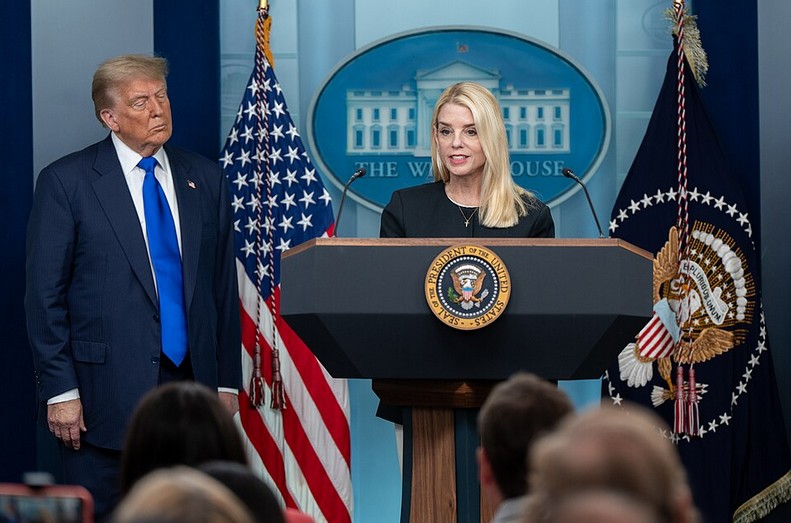
The saga began in March 2025, when Attorney General Pam Bondi, a longtime Trump ally, directed approximately 1,000 F.B.I. personnel to comb through roughly 100,000 Epstein-related documents, with explicit instructions to flag every instance where Mr. Trump’s name appeared, according to letters from Senator Dick Durbin, Democrat of Illinois. The review, conducted under a tight two-week deadline, was described by Mr. Durbin as “haphazard” and lacking the expertise needed to handle sensitive material involving child victims.
By May, Ms. Bondi and her deputy, Todd Blanche, privately briefed Mr. Trump, informing him that his name appeared multiple times in the files, according to reports from The Wall Street Journal and ABC News. They cited the presence of sensitive content, including child pornography and victims’ personal information, as a reason to withhold further public releases. Yet, just two months later, on July 7, the Justice Department and F.B.I. issued a joint memo declaring there was no “incriminating client list” or evidence warranting further investigation. Ms. Bondi publicly stated, “Nothing in the files warranted further investigation or prosecution,” signaling the case was closed.
This sequence, flagging Mr. Trump’s name en masse, briefing him privately, and then abruptly shutting down the inquiry, has raised suspicions of political interference. Critics, including bipartisan lawmakers and even some of Mr. Trump’s supporters, argue that the process was designed to suppress potentially damaging information about the president, whose past association with Epstein has long been documented, including a 2003 letter referenced in the files and his 2002 comment calling Epstein a “terrific guy.”
“It’s hard to see this as anything but a cover-up,” said Representative Jamie Raskin, Democrat of Maryland, who has called for an independent review of the F.B.I.’s handling of the files. “When you have a thousand agents scrambling to flag one person’s name, brief that person privately, and then tell the public there’s nothing to see, it erodes trust in our institutions.”
The investigation’s closure has also sparked internal tensions. Reports from The Daily Beast and others indicate that Dan Bongino, the deputy F.B.I. director and a vocal Trump supporter, considered resigning over disagreements with Ms. Bondi’s approach. Kash Patel, the F.B.I. director and another Trump appointee, faced criticism from Ms. Bondi for allegedly withholding files, though he has publicly endorsed the Justice Department’s findings. These rifts suggest dissent within the administration over the decision to bury the documents.
Ms. Bondi has defended her actions, citing grand jury secrecy laws that restrict the release of such records to protect victims and witnesses. “We followed the law to the letter,” she said in a statement on July 8. “The files contain sensitive information that cannot be made public without harming those affected by Epstein’s crimes.” Legal experts note that grand jury materials are indeed heavily protected, requiring court approval for disclosure, which is rarely granted.
However, the lack of transparency, particularly after Ms. Bondi’s earlier promises of major revelations, has fueled skepticism. In February 2025, she claimed an Epstein “client list” was “sitting on my desk,” raising expectations among Mr. Trump’s base for explosive disclosures. The July memo’s assertion that no such list exists, coupled with the release of largely redundant documents to influencers earlier in the year, has left even MAGA supporters feeling betrayed.
“The administration hyped this up for years, promising to expose Epstein’s network,” said Laura Loomer, a prominent conservative activist, in a post on X. “Now they’re saying there’s nothing? It smells like they’re protecting someone.”
The optics are further complicated by Mr. Trump’s documented ties to Epstein. Beyond the 2003 letter, the two men socialized in the 1990s and early 2000s, with Mr. Trump flying on Epstein’s private plane multiple times. While no credible evidence has emerged linking Mr. Trump to Epstein’s criminal activities, the targeted flagging of his name suggests the administration anticipated potentially embarrassing or damaging information.
Defenders of Ms. Bondi argue that the absence of a “client list” or actionable evidence justifies closing the case. “Being named in Epstein’s files doesn’t mean someone broke the law,” said Alan Dershowitz, a legal scholar who has represented high-profile figures. “The documents include unverified tips and witness statements. Releasing them could cause more harm than good.”
Yet the lack of a redacted summary or detailed public explanation has left many unconvinced. Senator Josh Hawley, Republican of Missouri, joined Democrats in demanding “full transparency” about the review process, questioning why the public was not given a clearer accounting of the flagged records.
The controversy follows a familiar pattern: intense internal action followed by a sudden public clampdown. This sequence, combined with Ms. Bondi’s role as a buffer for Mr. Trump and Mr. Patel’s shift from promoting Epstein conspiracy theories to endorsing the investigation’s closure, has deepened public distrust. Whether the withheld information is legally protected or politically inconvenient remains unclear, but the perception of a cover-up is undeniable.
As calls for an independent investigation grow, the Epstein files saga underscores a broader challenge for the Trump administration: balancing legal constraints with the demand for transparency in a case that has captivated the public for decades. For now, the documents remain sealed, and with them, the truth about what the F.B.I. found, and why it chose to keep it hidden.