

Last Updated on November 1, 2025 by ThePublic
Sometime after Oct. 27, 2025, right as the shutdown fight hit its ugliest point, USDA quietly pulled down a 55-page PDF called “FY2026 USDA Lapse Plan.” That document, dated Sept. 30, 2025, spelled out in black and white that USDA could keep SNAP running in a shutdown by tapping more than $5 billion in contingency reserves and following OMB guidance. That’s the plan anti-hunger lawyers, state agencies, and budget people all expected to see honored. Then, poof, GONE!
Within days of that deletion, the message on the “live” USDA site flipped to: sorry, can’t legally do it, blame Senate Democrats. That’s not just spin, that’s a retroactive rewrite of the record. The earlier version said the money was available; the new version says it’s not. Same agency. Same month. Different political need. (Axios)
That is what a cover-up looks like in 2025. You don’t burn the files, you unpublish the PDF.
Here’s a link to the original PDF put out on the USDA official governmental website.
Why delete it?
Because the document undercut the White House story line.
The administration is insisting “our lawyers say we can’t use the funds,” and that Democrats are forcing Americans to go hungry. But the deleted plan said the opposite, that SNAP is a “core nutrition safety net” that should continue uninterrupted during a lapse, and that there was money on hand to do it. That’s why two federal judges just ordered USDA to pay, because the law and the agency’s own previous guidance point in that direction. (FactCheck.org)
So the sequence looks like this:
- Sept. 30: USDA posts shutdown/lapse plan saying SNAP can be covered with existing funds. (Center on Budget and Policy Priorities)
- Oct. 1: Shutdown begins. SNAP still funded through October using that plan.
- Late Oct: USDA puts out a new memo saying, actually, contingency money isn’t “legally available” for November, a complete reversal. (Iowa Public Radio)
- After Oct. 27: Original plan disappears from USDA.gov, replaced by a political blame page.
- Oct. 28–31: States sue, judges say “pay the benefits,” administration still drags its feet and keeps blaming Democrats. (AP News)
That’s not confusion. That’s an about-face to match a political message.
Pair it with the other move: killing the hunger data
Now zoom out. Just 10 days before all this, USDA also killed the 30-year-old “Household Food Security in the United States” report, calling it “redundant, costly, politicized, and extraneous.” That’s the report that told us 47.4 million people were food-insecure, and rising. Kill the data, and you blunt the headlines when hunger spikes because you turned SNAP into a hostage.
So in the same month:
- They hid the plan that showed they could keep people fed.
- They ended the report that would have shown how much harm the cutoff caused.
That’s not coincidence. That’s narrative management.
The real play: weaponize hunger, then blame the enemy
Here’s the ugly heart of it. SNAP is usually boring, bipartisan, and automatic. This White House made it conditional, we’ll feed you if the other party caves. That’s why food banks today are scrambling to fill an impossible gap, saying openly they can’t replace 95 million meals in a month. They’re responding to a crisis that was optional.
Then, with the faucet turned off, the administration says: “Call Senate Democrats and tell them to reopen the government.” It’s using empty EBT cards as political mailers.
But the record, the deleted record shows it didn’t have to be empty.
Why it matters more than “just” SNAP
- It shows willingness to rewrite federal guidance after the fact. If agencies can erase inconvenient PDFs during a shutdown, every future fight over benefits, climate data, labor rules, or health numbers becomes a “he said, she said.” That’s catastrophic for accountability.
- It punishes states for trying to help. Several states said, “We’ll front the money,” and USDA immediately told them: do it and you might not get reimbursed. That’s not law, that’s pressure.
- It hides the trend line. Ending the annual hunger report means in 2026 the administration can claim “hunger is being exaggerated” and there will be no official, continuous USDA series to contradict them. That’s how you make a painful policy look mild. (Food Tank)
What a seething, honest headline would say
They erased the USDA plan that proved they could feed 42 million Americans — so they could starve the program and blame Democrats.
That’s the story.
Questions every reporter, lawmaker, and pissed-off SNAP parent should be asking
- Who specifically authorized the removal of the Sept. 30 “FY2026 Lapse Plan” from USDA.gov, and on what date? (Names, not “the web team.”)
- What changed in USDA’s legal interpretation between Sept. 30 and Oct. 27? Produce the memos.
- Did OMB issue new shutdown guidance contradicting the original USDA plan — or did USDA just decide to reinterpret it?
- Why was the annual Household Food Security report canceled on Sept. 20 — 10 days before a shutdown that would heighten hunger? Show the internal email chain.
- Why are states being told they won’t be reimbursed if they prevent their citizens from going hungry?
- Why did it take federal judges to force USDA to do what its own deleted plan already said was possible?
- Why did the public page get replaced with partisan messaging while 42 million people were being told “there is no money”?
What this administration will say and why it’s flimsy
- “We didn’t have enough, we needed $8B, we had only $5B.” But the deleted plan explains how to bridge a short-term lapse using exactly that fund. That’s what it was for.
- “Courts are split.” Yes, because the administration reversed itself, not because the law suddenly got confusing. Judges are ruling based on what USDA said first. (Politico)
- “This is about Democratic obstruction.” No, that narrative appeared after the plan was taken down, not before. That’s backward cause and effect.
Bottom line
You found the right phrase earlier: this is the smoking gun. The only reason we know it ever existed is because the Internet Archive and outside groups captured it before USDA could vanish it. That’s the tell. If it helped their story, it would still be live. Because it hurt their story, it disappeared. That’s a cover-up.
Editor’s Note:
On October 30, 2025, the USDA homepage began displaying a partisan message accusing “Senate Democrats” of voting 13 times to block SNAP funding and linking food-aid delays to unrelated culture-war issues. This is unprecedented since federal law bars executive agencies from using taxpayer-funded websites for political propaganda under the Hatch Act (5 U.S.C. § 7323) and the Anti-Lobbying Act (18 U.S.C. § 1913).
The irony is that, only weeks earlier, the same USDA quietly deleted its “FY 2026 USDA Lapse Plan” a 55-page contingency document archived by the Internet Archive, explicitly outlining how the department could continue SNAP operations during a funding lapse using reserve appropriations. In other words, the agency publicly claimed the “well had run dry” while privately possessing a plan (and authority) to keep feeding millions of Americans.
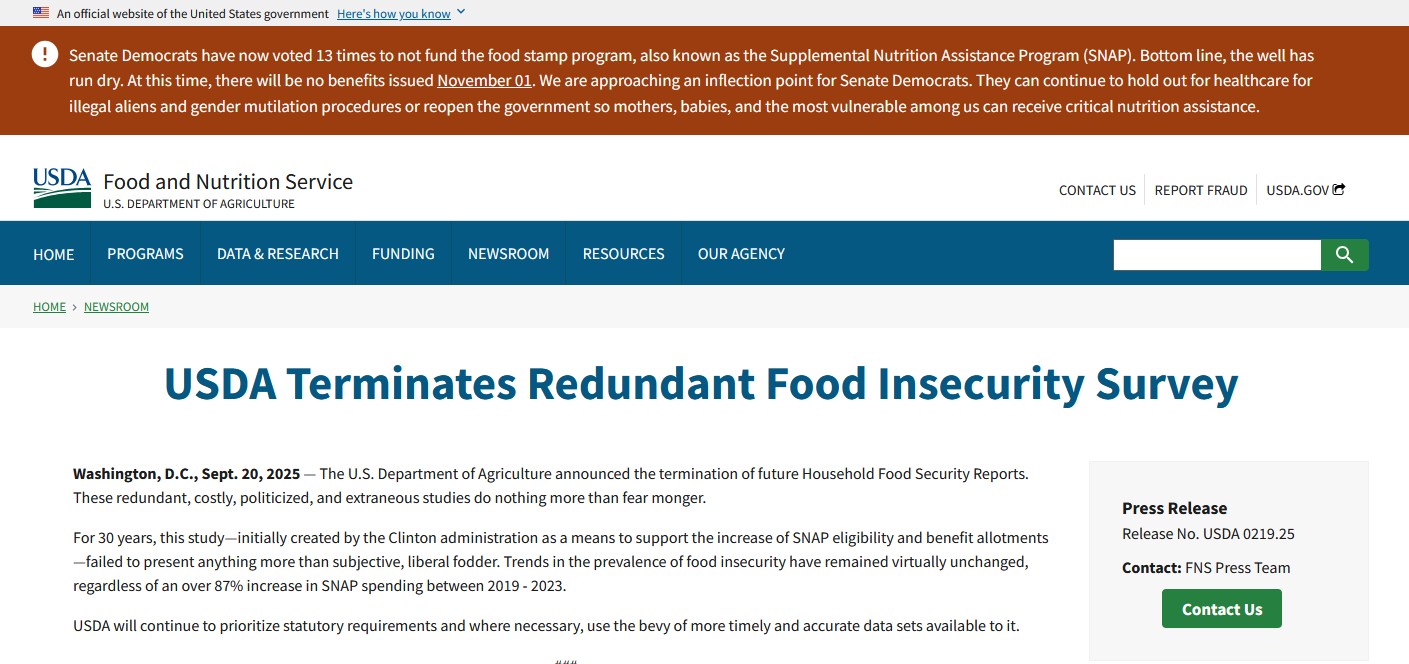
Sources: Wayback Machine archive of the FY 2026 Lapse Plan (Oct 10 2025 capture); Hatch Act and Anti-Lobbying Act statutory texts; USDA FNS.gov banner retrieved Nov 1 2025.