
Last Updated on June 5, 2025 by ThePublic
Trump’s Controversial Easter Message and What is Says About the Man
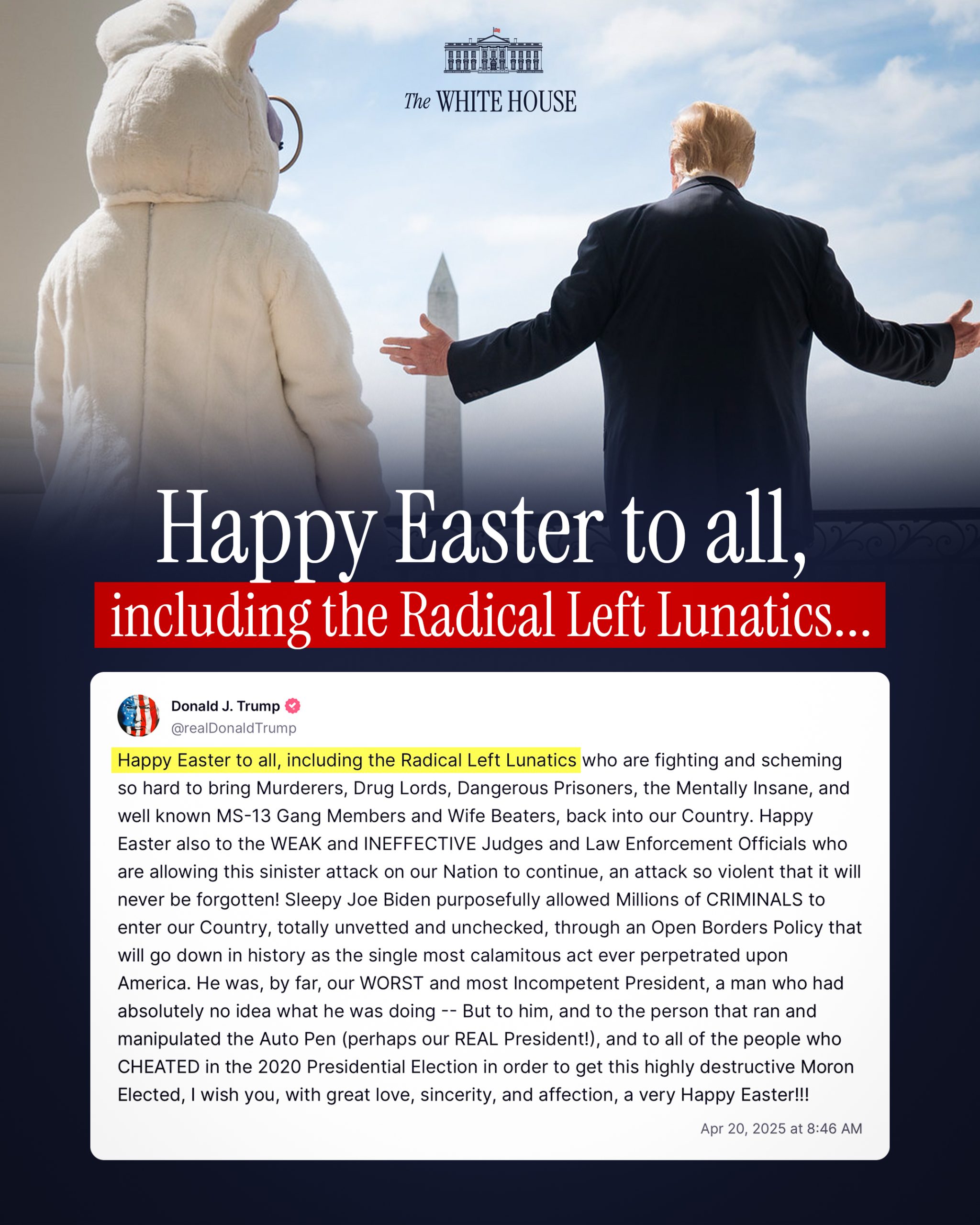
On April 20, 2025, a message attributed to Donald J. Trump was shared from the White House, extending Easter greetings to the public. While the message began with a seemingly inclusive tone, it quickly pivoted to a highly critical and divisive narrative, targeting various groups and individuals. This article examines the statements made in the message, critiques its tone, and addresses the broader implications of such rhetoric in a public communication.
Overview of the Message
The message starts with a broad Easter greeting, stating, “Happy Easter to all, including the Radical Left Lunatics…” However, it immediately shifts to a series of accusations, labeling certain groups as “MS-13 Murderers, Drug Lords, Dangerous Prisoners, the Mentally Insane, and well known MS-13 Gang Members and Wife Beaters.” It also references an “attack on our Country” and attributes the entry of “Millions of CRIMINALS” to an “Open Borders Policy” under the previous administration, specifically targeting “Sleepy Joe Biden” as the “WORST and most incompetent President.” The message concludes by addressing those who allegedly “CHEATED in the 2020 Presidential Election” and wishes them a “Happy Easter” with “great love, sincerity, and affection.”
Critique of the Statements
The message contains several claims that warrant scrutiny. First, the characterization of immigrants as “MS-13 Murderers, Drug Lords, Dangerous Prisoners, the Mentally Insane, and well known MS-13 Gang Members and Wife Beaters” is a gross generalization that lacks evidence. While issues like crime and border security are valid topics for policy discussion, conflating entire groups of people with extreme criminal behavior perpetuates harmful stereotypes.
Data from the U.S. Customs and Border Protection agency indicates that the majority of individuals crossing the border are seeking asylum or economic opportunities, not engaging in criminal activity. Moreover, studies, such as those from the American Immigration Council, have shown that immigrants are less likely to commit crimes than native-born citizens.
The claim that “Millions of CRIMINALS” entered the country due to an “Open Borders Policy” under President Biden is also misleading. The term “open borders” oversimplifies a complex issue. The Biden administration did adjust some immigration policies, such as ending the “Remain in Mexico” program, but it also maintained several enforcement measures, including Title 42 expulsions during the COVID-19 pandemic. Additionally, the accusation that these policies led to an influx of millions of criminals is unsubstantiated. Official statistics from the Department of Homeland Security do not support the notion of a mass entry of criminals, and such rhetoric inflames fear rather than fostering constructive dialogue.
The message also references an “attack on our Country” by “Radical Left Lunatics,” which appears to be a rhetorical device rather than a specific event. This vague language risks alienating large segments of the population by framing political opponents as enemies, rather than fellow citizens with differing views. Finally, the assertion that the 2020 Presidential Election was “CHEATED” continues to propagate a narrative that has been widely debunked by courts, election officials, and independent observers. Over 60 lawsuits challenging the 2020 election results were dismissed for lack of evidence, and multiple recounts confirmed the integrity of the outcome.
Analysis of Tone
The tone of the message is notably harsh and polarizing. Terms like “Radical Left Lunatics,” “Sleepy Joe Biden,” and “WORST and most incompetent President” are not only derogatory but also undermine the dignity expected of official communications from the White House. Public statements from such a platform should aim to unite rather than divide, especially during a holiday like Easter, which is traditionally associated with themes of renewal and community.
The use of all-caps for words like “CRIMINALS,” “WORST,” and “CHEATED” amplifies the aggressive tone, giving the impression of shouting rather than reasoned discourse. This approach can be perceived as authoritarian, as it seeks to assert dominance through emotional appeals rather than engaging with substantive policy critiques. Such a tone risks alienating those who might otherwise be open to a more measured discussion of immigration, border security, or election integrity.
Broader Implications
The rhetoric in this message has significant implications for public discourse. By framing political opponents and immigrants as existential threats, it deepens societal divisions and fosters an “us versus them” mentality. This approach can erode trust in institutions, as seen with the continued propagation of election fraud claims, which undermines confidence in democratic processes.
Moreover, the message’s tone and content may contribute to a climate of fear and hostility toward marginalized groups, particularly immigrants. Leaders have a responsibility to model civility and promote policies based on facts, not stereotypes or unsubstantiated claims. While the message concludes with an expression of “great love, sincerity, and affection,” this sentiment feels incongruous with the preceding criticism, making the overall communication appear disingenuous.
Conclusion
The Easter message from the White House on April 20, 2025, while intended as a holiday greeting, veered into divisive and inflammatory territory. Its sweeping generalizations about immigrants, unsubstantiated claims about border policies, and harsh tone toward political opponents detract from the spirit of unity that such occasions should inspire. Moving forward, public communications from leaders should strive for a more inclusive and factual approach, fostering dialogue rather than division. Easter, as a time of reflection and renewal, deserves a message that reflects those values in both content and tone.