
Last Updated on July 14, 2025 by ThePublic
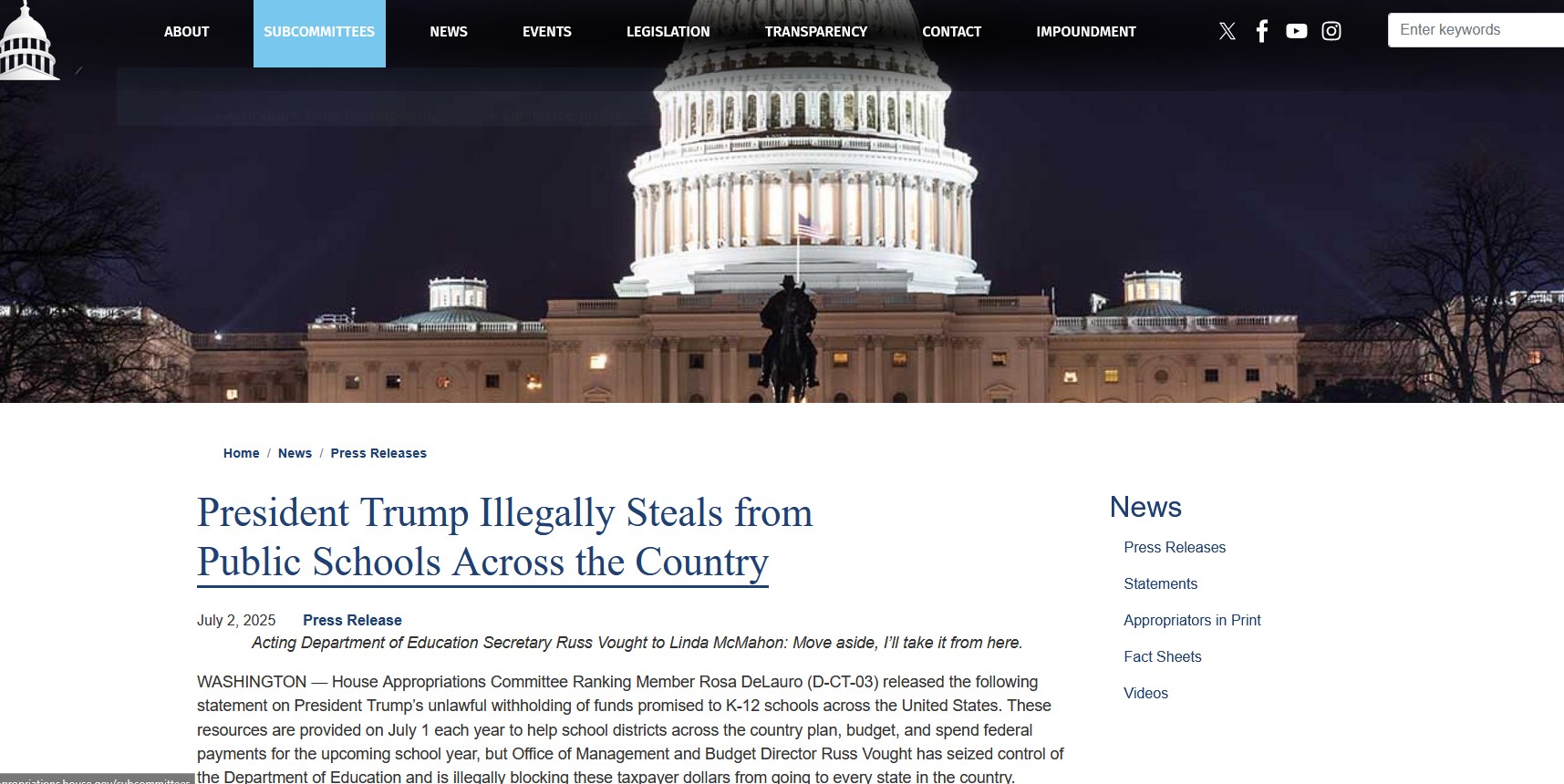
In a move that can only be described as a calculated assault on the future of America’s youth, the Trump administration is illegally withholding nearly $7 billion in federal funding promised to public schools across the United States. This brazen act, spearheaded by Office of Management and Budget Director Russ Vought, is not just a bureaucratic overreach, it is a deliberate attempt to starve the nation’s education system, leaving children, teachers, and communities to bear the consequences of Republican disdain for public education.
Please note, these funds, $6.88 billion, were already approved by Congress and signed into law by President Trump himself, as well as being approved through a bipartisan vote.
Each year, on July 1, school districts rely on federal funds to plan budgets, hire teachers, and sustain critical programs. This year, those funds, approved with bipartisan support and signed into law by President Trump himself, have been frozen. The result? Classrooms are left in chaos, teachers face layoffs, and programs that support the most vulnerable students are at risk of collapse. This is not an accident; it is a feature of an administration that prioritizes power grabs over the needs of children.
The withheld funds, totaling $6.88 billion for Fiscal Year 2024, support essential programs: professional development for teachers, afterschool enrichment, mental health services, STEM education, and language instruction for English learners and migrant children. In states like California, where $928 million is at stake, or Texas, with $739 million on the line, the impact is catastrophic. Even smaller states like Vermont ($26 million) and Wyoming ($25.5 million) face devastating cuts that threaten the stability of their schools. These are not abstract numbers, they represent teachers’ livelihoods, children’s opportunities, and communities’ futures.
The Trump administration is unlawfully withholding funding for the following education programs:
- Supporting Effective Instruction State Grants (Title II-A), which support professional development and other activities to improve the effectiveness of teachers and school leaders, including reducing class size.
- 21st Century Community Learning Centers (Title IV-B), which support high-quality before and after-school programs focused on providing academic enrichment opportunities for students.
- Student Support and Academic Enrichment Grants (Title IV-A), which provide flexible funding for school districts for a wide range of activities, including supporting STEM education, accelerated learning courses, college and career counseling, school-based mental health services, and improving school technology, among many others.
- English Language Acquisition (Title III-A), which supports language instruction to help English language learners become proficient in English.
- Migrant Education (Title I-C), which supports the educational needs of migratory children, including children of migrant and seasonal farmworkers.
- Adult Basic and Literacy Education State Grants (including Integrated English Literacy and Civics Education State Grants), which support adult education and literacy programs to provide the basic skills to help prepare adults and out-of-school youth for success in the workforce.
Representative Rosa DeLauro, the ranking Democrat on the House Appropriations Committee, has called this move what it is: unlawful. “President Trump is actively working to kick teachers out of classrooms, end afterschool programs, and create uncertainty and chaos,” she said. Her outrage is echoed by Senate Democrats Patty Murray and Tammy Baldwin, who have demanded answers from a Department of Education that appears to have ceded control to Vought’s OMB. Education Secretary Linda McMahon, sidelined in her own agency, has been reduced to a bystander as Vought consolidates power, wielding what DeLauro calls a “made-up theory of ‘pocket rescissions’”—a maneuver courts have repeatedly struck down as unconstitutional.
This is not just a policy dispute; it is a moral failing. Public schools are already stretched to the breaking point. Teachers, underpaid and overworked, are forced to buy classroom supplies out of their own pockets. Class sizes are ballooning, and students, especially those in underserved communities—are losing access to the resources they need to thrive. The Trump administration’s decision to choke off funding for programs like 21st Century Community Learning Centers, which provide safe spaces for students after school, or Migrant Education grants, which support children of seasonal farmworkers, reveals a callous indifference to the most vulnerable among us.
The administration’s actions fit a broader pattern: a relentless campaign to dismantle public education. DeLauro and 192 House Democrats have already taken legal action to challenge Trump’s efforts to shutter the Department of Education entirely. This latest stunt, blocking funds that Congress lawfully allocated, underscores a chilling agenda. By starving schools, the administration is not just undermining education; it is undermining democracy itself, which depends on an informed and empowered citizenry.
The human toll is already evident. In rural Alabama, where $100 million in funding hangs in the balance, schools may cut back on counselors and advanced courses. In New York, with $464 million at stake, urban districts face the prospect of slashing afterschool programs that keep kids off the streets. Parents are left scrambling, teachers are demoralized, and students are robbed of opportunities they were promised. This is the legacy of an administration that claims to champion “America First” while putting America’s children last.
The solution is clear: Secretary McMahon must reclaim control of the Department of Education and release the funds immediately. Congress must hold Vought and the administration accountable for this illegal overreach. And Americans must demand that their leaders prioritize the education of the next generation over political power plays. Anything less is a betrayal of our children and our future.
A state-by-state breakdown of how much funding is at stake is below.
| State | Fiscal Year 2024 Funding | Fiscal Year 2025 Funding |
| Alabama | $100,392,656 | ??? |
| Alaska | $47,665,907 | ??? |
| Arizona | $134,262,493 | ??? |
| Arkansas | $64,255,707 | ??? |
| California | $927,965,332 | ??? |
| Colorado | $79,619,065 | ??? |
| Connecticut | $53,561,846 | ??? |
| Delaware | $28,585,105 | ??? |
| District of Columbia | $26,683,109 | ??? |
| Florida | $398,177,922 | ??? |
| Georgia | $223,888,870 | ??? |
| Hawaii | $33,290,327 | ??? |
| Idaho | $36,493,633 | ??? |
| Illinois | $243,191,750 | ??? |
| Indiana | $107,174,260 | ??? |
| Iowa | $44,494,874 | ??? |
| Kansas | 49,946,530 | ??? |
| Kentucky | 96,495,478 | ??? |
| Louisiana | 119,812,747 | ??? |
| Maine | 27,630,253 | ??? |
| Maryland | 110,193,772 | ??? |
| Massachusetts | 107,694,933 | ??? |
| Michigan | 173,716,752 | ??? |
| Minnesota | 74,106,362 | ??? |
| Mississippi | 71,654,231 | ??? |
| Missouri | 93,962,471 | ??? |
| Montana | 27,978,071 | ??? |
| Nebraska | 38,149,509 | ??? |
| Nevada | 61,212,651 | ??? |
| New Hampshire | 27,004,029 | ??? |
| New Jersey | 162,462,714 | ??? |
| New Mexico | 49,847,565 | ??? |
| New York | 463,833,139 | ??? |
| North Carolina | 185,874,769 | ??? |
| North Dakota | 26,573,545 | ??? |
| Ohio | 203,510,265 | ??? |
| Oklahoma | 77,827,922 | ??? |
| Oregon | 80,991,681 | ??? |
| Pennsylvania | 230,714,211 | ??? |
| Rhode Island | 29,371,806 | ??? |
| South Carolina | 94,118,605 | ??? |
| South Dakota | 27,200,921 | ??? |
| Tennessee | 118,985,396 | ??? |
| Texas | 738,537,697 | ??? |
| Utah | 40,402,965 | ??? |
| Vermont | 26,125,325 | ??? |
| Virginia | 123,536,510 | ??? |
| Washington | 150,695,542 | ??? |
| West Virginia | 32,494,457 | ??? |
| Wisconsin | 80,333,097 | ??? |
| Wyoming | 25,545,207 | ??? |
| Total | 6,880,834,000 | ??? |